
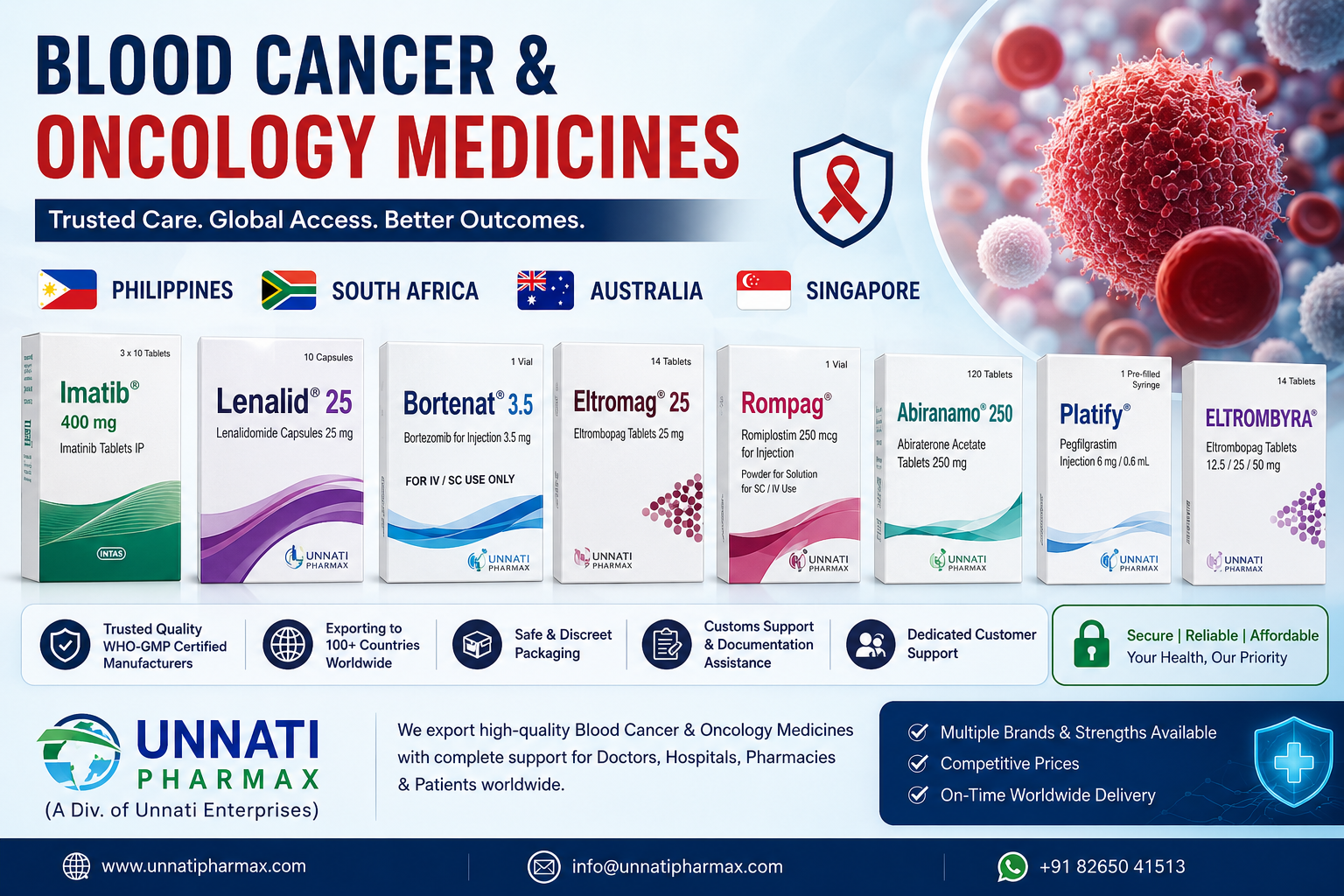
Cancer remains one of the world’s leading causes of death, and access to life-extending cancer medicines is one of the defining healthcare equity challenges of our era. For patients in the Philippines, South Africa, Australia, and Singapore, the cost of branded oncology medicines can be the difference between treatment and abandonment of care. Unnati Pharmax’s complete anti-cancer range delivers WHO-GMP certified generic oncology medicines — at a fraction of brand cost — directly to patients across these four markets with full quality documentation and reliable international delivery.
Visit unnatipharmax.com | 📱 +91 82650 41513 | 📧 Unnatipharmax@gmail.com
 FAQ 1: How does Singapore’s National Cancer Centre (NCCS) manage myeloma and what role does affordable Lenalid or Bortenat play for Singapore patients?
Singapore’s National Cancer Centre Singapore (NCCS) — part of Singapore General Hospital’s integrated campus at Outram Park — is Southeast Asia’s most recognised cancer centre, managing haematological malignancies including multiple myeloma for Singapore’s population and for medical tourism patients from across Southeast Asia. NCCS’s myeloma programme follows the latest IMWG and ESMO guidelines — incorporating novel agent combinations including Daratumumab-VRD induction, post-ASCT Lenalidomide maintenance, and CAR-T therapy (being introduced at Singapore General from 2025). Singapore’s drug subsidy framework (Medifund, subsidised care tiers at SGH) provides meaningful cost reduction for Singapore citizens and permanent residents on approved cancer drug regimens — Lenalidomide and Bortezomib are on Singapore’s cancer drug list with subsidy at restructured hospital settings. For Singapore’s substantial private healthcare users — choosing private oncologist care at Gleneagles, Mount Elizabeth, or Raffles — full brand pricing applies without subsidy: brand Revlimid at SGD $3,000-5,000/month and brand Velcade at SGD $2,000-3,500 per cycle create significant financial burden. Lenalid 25mg and Bortenat 3.5mg from Unnati Pharmax at dramatically reduced cost serve Singapore’s private myeloma patients — providing the evidence-based treatment that NCCS protocols recommend, at a cost that makes sustained long-term therapy financially realistic for Singapore’s cost-conscious private healthcare patients even at the Lion City’s high income levels.
FAQ 2: What is the CML burden in the Philippines and how has Imatib transformed outcomes for Filipino patients?
The Philippines CML story — documented in a previous Daily Common blog — remains one of the most compelling demonstrations of generic oncology medicine’s transformative potential. By 2026, the Philippines’ accessible generic Imatinib (Imatib) landscape has produced measurable population-level improvements in CML management: more Filipino CML patients are achieving major molecular response (BCR-ABL below 0.1%) and complete cytogenetic response than in any prior era; CML blast crisis presentations — once the common scenario as patients presented with unaffordable diagnosis-to-treatment timelines — are declining; and Philippine General Hospital’s haematology department has reported improved treatment adherence rates correlating with generic Imatinib affordability. The remaining challenge: approximately 30-40% of Filipino CML patients still face access barriers — primarily the diagnostic cost of PCR monitoring (BCR-ABL quantification) required for treatment response assessment, which ranges from PHP 3,000-8,000 per test at Philippine private laboratories; the medication itself (Imatib from Unnati Pharmax) being affordable is only part of the solution. Philippine haematologists are advocating for government subsidisation of BCR-ABL PCR testing through PhilHealth as the next essential step in CML elimination — recognising that affordable Imatib without affordable monitoring creates incomplete CML management. Unnati Pharmax actively supports Filipino CML patients in connecting with Philippine General Hospital’s subsidised monitoring services wherever possible.
FAQ 3: How does South Africa’s private oncology sector use Abiranamo and Eltromag from Unnati Pharmax alongside public sector cancer care?
South Africa’s cancer care landscape has a stark public-private divide that Unnati Pharmax’s affordable generics help bridge. The public sector — Groote Schuur Hospital (Cape Town), Chris Hani Baragwanath Academic Hospital (Johannesburg), and Inkosi Albert Luthuli Central Hospital (Durban) — provides free cancer treatment to South Africans without medical aid but with very limited formularies for targeted therapy and novel oncology agents. Abiraterone (Abiranamo) and Eltrombopag (Eltromag/Rompag) are typically not available through South Africa’s public oncology sector outside specific research programmes — prostate cancer patients in public hospitals typically receive ADT without Abiraterone intensification, and ITP/aplastic anaemia patients receive immunosuppression without Eltrombopag augmentation. The private sector — serving Discovery Health, Bonitas, Momentum medical aid members — provides Abiraterone and Eltrombopag brand equivalents with medical aid coverage, often subject to pre-authorisation. For South Africans working in the informal economy, in self-employed roles, or earning above public eligibility thresholds but below comfortable medical aid levels — the “missing middle” of approximately 25-35% of South Africa’s population — Abiranamo 250mg and Eltromag 25mg from Unnati Pharmax at dramatically reduced cost provides affordable access to these life-changing medicines that neither public sector nor private sector adequately serves for their specific economic situation.
FAQ 4: How does Australia’s PBAC process determine which anti-cancer medicines like Lenalid and Bortenat become PBS-listed and why does this matter for patients?
Australia’s Pharmaceutical Benefits Advisory Committee (PBAC) — an independent statutory body that advises the Health Minister on PBS listing — makes the critical decisions determining which cancer medicines become PBS-funded for Australian patients. The PBAC process for oncology: pharmaceutical company submits a submission with clinical evidence (trials demonstrating efficacy), cost-effectiveness modelling (comparing new medication cost against benefit in QALYs — Quality-Adjusted Life Years), and proposed patient eligibility criteria; PBAC assesses whether the medication provides sufficient clinical benefit at an acceptable cost-effectiveness threshold (approximately AUD 50,000-75,000 per QALY gained); if approved, the medication is PBS-listed with specified patient eligibility criteria. Lenalidomide’s PBS journey: first listed for myeloma in 2010 for relapsed disease; subsequently expanded to include maintenance post-ASCT and front-line combinations through successive PBAC positive recommendations. Bortezomib’s PBS listing: initial listing for myeloma, expanded to include mantle cell lymphoma and amyloidosis indications over time. The PBAC process creates approximately 12-18 month delays between international regulatory approval and Australian PBS availability — during which Australian patients either pay full private costs or access through clinical trials. Lenalid 25mg and Bortenat 3.5mg from Unnati Pharmax serve Australian patients precisely in these PBAC approval lag periods — as bridges to PBS availability for newly approved indications — as well as for non-Medicare-eligible international residents who cannot access PBS regardless of PBAC listing.
FAQ 5: What is Unnati Pharmax’s vision for expanding oncology medicine access in Philippines, South Africa, Australia, and Singapore through 2027?
Unnati Pharmax’s 2026-2027 oncology access expansion strategy for our four key markets reflects both growing patient demand and evolving treatment landscapes. Product pipeline: as additional oncology medicines lose patent protection and WHO-GMP Indian generics become available, Unnati Pharmax will expand beyond our current Imatib, Lenalid, Bortenat, Eltromag, Rompag, Platify, ELTROMBYRA, and Abiranamo portfolio — evaluating generic equivalents of Dasatinib, Nilotinib, Gefitinib, Erlotinib, and Everolimus as these reach generic availability under WHO-GMP manufacturing. Market-specific expansion: Philippines — B2B partnership development with Philippine Oncology Society member oncologists and Philippine Cancer Society chapters to create formal referral pathways for patients needing generic oncology access; South Africa — collaboration with Reach for Recovery and Cancer Association of South Africa (CANSA) for patient education about affordable generic oncology options; Australia — expanding our institutional relationships with haematology departments at Royal North Shore, Westmead, and RBWH for efficient private supply arrangements; Singapore — NCCS patient services awareness to ensure Singapore patients are informed about affordable generic alternatives when private brand oncology costs are discussed. Quality commitment: all future oncology products will maintain our non-negotiable WHO-GMP certification standard — as cancer medicine quality is more critical than any other pharmaceutical category, our quality assurance commitment intensifies rather than relaxes as we expand. Contact Unnatipharmax@gmail.com to register interest in new oncology product additions or institutional partnership discussions across all four markets.
You can Visti us ::
Contcat Number :: +91- 82650 41513
Gmail Id :: unnatipharmax@gmail.com



Add comment