

Product introduction
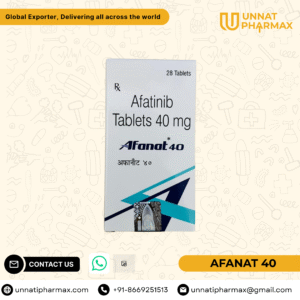
Afanat 40 Tablet is used in the treatment of non-small cell lung cancer. It is used in the treatment of adult patients who have certain mutations of epidermal growth factor receptor (EGFR).
Afanat 40 Tablet should be taken on an empty stomach, but try to have it at the same time every day to get the most benefits. Your doctor will decide what dose is necessary and how often you need to take it. This will depend on what you are being treated for and may change from time to time. You should take it exactly as your doctor has advised. Taking it in the wrong way or taking too much can cause very serious side effects. It may take several weeks or months for you to see or feel the benefits but do not stop taking it unless your doctor tells you to.
The most common side effects of this medicine include diarrhea, rash, dry skin, and nausea. Diarrhea can be serious sometimes so take medicine to treat it as prescribed by the doctor or stay hydrated. Your doctor may advise for some blood tests while you are taking this medicine. It may also make your skin sensitive to the sun, so use sunscreen and wear protective clothing if you have to be in sunlight. Inform your doctor if you notice pain or redness in the eye or dry eye.
Before taking it, tell your doctor if have a breathing problem, liver, or kidney problems, or are taking any medicines to treat infections. Many other medicines can affect, or be affected by, this medicine so let your healthcare team know all medications you are using. This medicine is not recommended during pregnancy or while breastfeeding. The use of effective contraception by females during treatment is important to avoid pregnancy.
Uses of Afanat Tablet
- Non-small cell lung cancer
Benefits of Afanat Tablet
In Non-small cell lung cancer
Side effects of Afanat Tablet
Common side effects of Afanat
- Diarrhea
- Rash
- Dry skin
- Nausea
- Vomiting
- Loss of appetite
- Itching
- Stomatitis (Inflammation of the mouth)
- Nail disorder
How to use Afanat Tablet
How Afanat Tablet works
Safety advice

Alcohol

Pregnancy

Breast feeding

Driving

Kidney

Liver
What if you forget to take Afanat Tablet?
Quick tips
- You have been prescribed Afanat 40 Tablet for the treatment of certain type of lung cancer (non-small cell lung cancer).
- Take Afanat 40 Tablet on an empty stomach at least 1 hour before a meal or 2 hours after a meal.
- Diarrhea is common with Afanat 40 Tablet and may sometimes be severe. Your doctor may prescribe medicines to treat diarrhea. Stay hydrated and take this medicine exactly as directed.
- Afanat 40 Tablet can make your skin sensitive to the sun. Limit your time in the sun. Use sunscreen and wear protective clothing if you have to be in sunlight.
- Afanat 40 Tablet can cause redness, rash, and acne. Get treatment for skin reactions as soon as you notice them.
- Use a reliable contraceptive method to prevent pregnancy while you are taking this medicine and for a month after you stop taking it.
- Monitor your blood pressure regularly while taking this medication. Inform your doctor if you notice symptoms of very high blood pressure such as severe headache, confusion, problems with your eyesight, nausea or vomiting.
- Do not take this medicine if you are pregnant, planning to conceive or breastfeeding.
- Afanat 40 Tablet is used for the treatment of thyroid cancer.
- Take it with or without food, preferably at the same time each day.
- Diarrhea may occur as a side effect. Drink plenty of fluids and inform your doctor if it doesn’t stop or if you find blood in your stools.
- Use a reliable contraceptive method to prevent pregnancy while you are taking this medicine and for a month after you stop taking it.
- Monitor your blood pressure regularly while taking this medication. Inform your doctor if you notice symptoms of very high blood pressure such as severe headache, confusion, problems with your eyesight, nausea or vomiting.
- It may cause serious bleeding problem. Inform your doctor if you get headaches, stomach pain or if you notice blood in your urine or stools.
- Do not take this medicine if you are pregnant, planning to conceive or breastfeeding.
FAQs
Is Afanat 40 Tablet an immunotherapy or chemotherapy?
How long does it take for Afanat 40 Tablet to work?
How should I take Afanat 40 Tablet?
Does Afanat 40 Tablet have any effect on fertility?
Can Afanat 40 Tablet be given along with chemotherapy?
Can Afanat 40 Tablet cure lung cancer?
What should I avoid while taking Afanat 40 Tablet?
Can I do something if I get diarrhea due to Afanat 40 Tablet?
References:-
- Philippines Food and Drug Administration (FDA) – Drug Registration (Specific Product):
- https://verification.fda.gov.ph/med_cancerview.php?showdetail=&id=841
- (Registration entry for Afatinib (As Dimaleate) 30mg Film-Coated Tablet, confirming local approval and generic name.)
- U.S. Food and Drug Administration (FDA) – Drug Label (Gilotrif/Afatinib):
- https://www.accessdata.fda.gov/drugsatfda_docs/label/2018/201292s014lbl.pdf
- (FDA label confirming the 30mg dose form and recommending it for Severe Renal Impairment, and as a dose reduction step.)
- NIH – PubMed Central (PMC) – Clinical Trial Review (Survival Data):
- https://www.jcancer.org/v10p0885
- (Meta-analysis confirming Afatinib significantly prolonged Overall Survival (OS) and Progression-Free Survival (PFS) in advanced NSCLC patients.)
- NIH – PubMed Central (PMC) – Real-World Dosing/Efficacy Study:
- https://pmc.ncbi.nlm.nih.gov/articles/PMC9264103/
- (A study discussing the use of Afatinib 30mg and its efficacy in various EGFR-mutated lung adenocarcinomas, supporting the use of adjusted dosing.)
- ResearchGate – Review on Dose Reduction & Toxicity:
- https://www.tandfonline.com/doi/full/10.2217/lmt-2019-0004
- (Phase IV study discussing the use of Afatinib (including the 30mg dose) in second-line NSCLC, and the strategy of dose reduction to manage toxicity without compromising efficacy.)

Reviews
There are no reviews yet.